
As the Heidelberg Catechism states in its 54th question and answer, the Holy Church is eternal: „from the beginning to the end of the world,” the Son of God gathers His people into His communion. At the same time, the problems associated with the human aspect of the Holy Church are also eternal. We must speak of both.
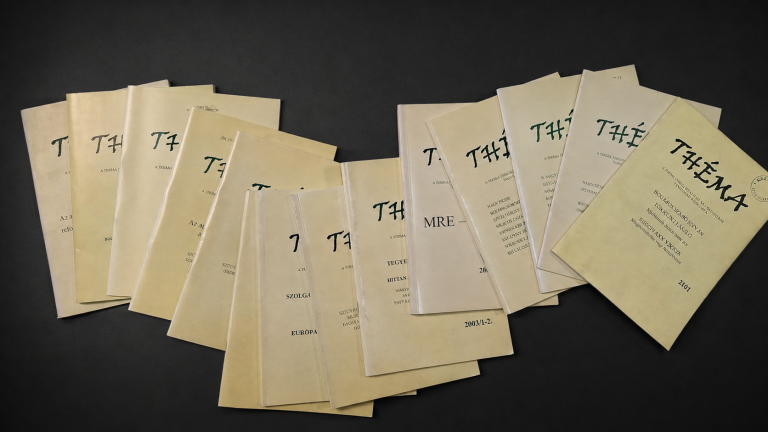
Following a conference on 7 April 1997, a group of pastors from the Danubian and the Transdanubian Reformed Church Districts discussed how to create opportunities for theological discussion within the Church, independent of established ‘interest groups’. This marked the beginning of the THÉMA (Theological Life Today)[1] Protestant Study Group’s history. Two years later, in parallel with the registration process in 1999, the group launched the  journal. The journal aimed to create a space in the church’s public sphere that did not previously exist.
We sought to present the church’s current situation. We wanted to provide an unvarnished diagnosis of our current situation. Theologians, historians, sociologists, lawyers, psychologists, educators, economists and managers all contributed. Looking back at the published issues of , it is clear that the anomalies uncovered in the first ten years following the regime change, and the problems detected twenty years later, have not disappeared. Even after another fifteen years, these issues persist.
Therefore, it is entirely appropriate that we continue to consider how we think about and speak of God today. Do we even talk about Him? Does theological discourse exist, and if so, what is it like? There are no taboo topics, yet we have many questions. Why have people turned away from the Church? The relationship between the church and political power is still—perhaps even more so—relevant to consider. What is the relationship between theology and politics? And so on.
The fact that the THÉMA study group ceased its activities, including regular community discussions and conferences, after Professor László Kósa made public the list of church agents he had uncovered at our 2010 conference and published it in our journal, is significant in itself. Without the association’s activities, the journal also ran out of steam.
Another reason for the association’s decline was that some of its members took up significant positions in the church, politics and higher education following the 2002 church elections. However, as a result, the diagnoses and proposed remedies presented to the public by the association had very little impact on the life of the church.
In 2011, István Szabó, who was then in his second term as bishop, lamented that „Our church has no real forum for debate. Not even THÉMA is really a forum for debate.” Despite the increasing number of schools of the church, the number of young people in the church is dwindling. Meanwhile, László Tőkéczky, a historian and chief clerk of the church district, continues to regard the failure to engage the intelligentsia and the lack of their theological education as the most glaring shortcomings.[2]
To this day, there is no active public discourse within the church. Theological and church-political writings appear in traditional channels such as Teológiai Szemle, Confessio and Reformátusok Lapja, as well as on the websites of the MRE and church districts. These are generally devoid of lively discourse.
There are smaller online platforms that are either not well known enough or have become closed off, so they do not reach many readers or listeners who could respond to the issues raised. Podcasts and other online discussions have also failed to foster in-depth theological exchange.
Yet there is a great need for as many open and public forums as possible where people can express themselves, engage in conversation and form opinions if they wish to serve the Church. Only through ongoing discourse can we foster shared theological thinking, process the ever-changing events of daily life and craft responses to them. Moreover, this is how we can move beyond formulating retrospective responses to society forced into a corner by political decisions, and instead offer prophetic, forward-looking statements.
As the former editor-in-chief of the journal, I am therefore pleased to support the launch of théma21. I hope it will provide an opportunity for open, honest yet committed expressions and dialogues, both humanly, spiritually and even professionally. The topic (thema) is given…
References
- the word ‘téma’ means ‘topic’
- Bogárdi Szabó István – Tőkéczki László: „Mi történt és mi nem? Egyházunk elmúlt húsz éve”, THÉMA 13 (2011) 8-9. 17-18.